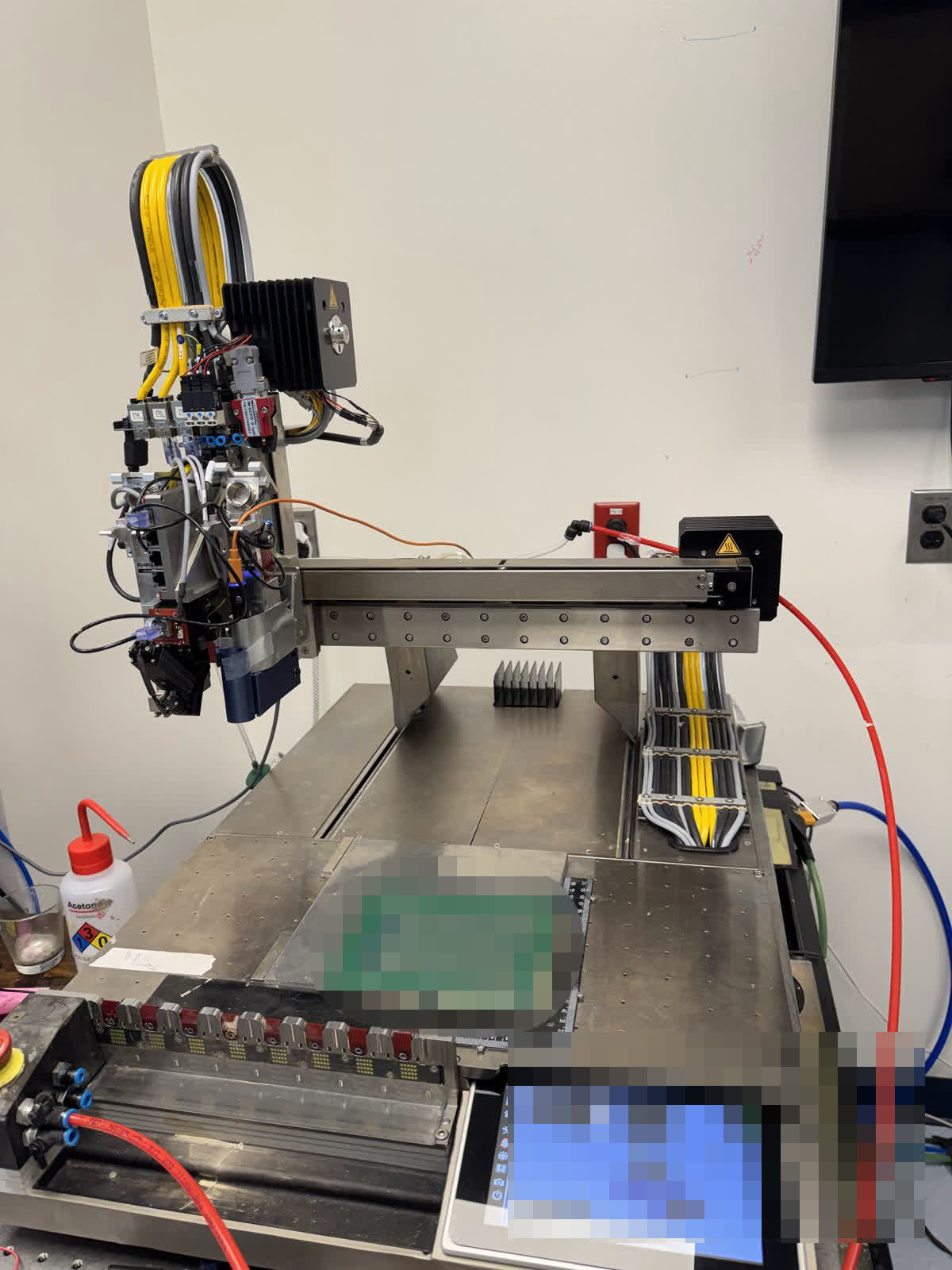
inkjet printing of biosensor panels (Marco S-Jet)
- My contribution
- Led machine integration as principal engineer, covering fixtures, job-file generation, and printing and curing procedures.
- File conversion
- Python converter that reads board-design coordinates from CSV files and generates the dispenser's XML job files.
- Printing process
- Conductive and insulating inks are printed onto the panel. The insulating ink is then cured under ultraviolet light.
The Marco S-Jet prints conductive traces and insulating layers onto boards that already carry the graphene sensing pattern. The conductive ink forms electrical connections, while the insulating ink prevents shorts.
I wrote the software that converts board-design data into dispenser jobs and led the machine’s integration into the lab’s board-production process.
From design CSV to job XML
Board designs provide coordinates in CSV files, while the dispenser requires XML job files. Preparing these jobs manually meant translating hundreds of points between different coordinate systems and units.
I wrote a Python converter to handle the coordinate mapping, unit conversion, and separate instructions for each ink. When a board design changes, the job files can be regenerated from the updated CSVs. Git diffs show which points changed.
Machine integration
As principal engineer for the integration, I worked on fixtures for the lab’s panel geometries, connected the design data to the dispenser’s job format, and established the printing and curing steps.
After printing, the insulating ink is cured in a UV tunnel.
Related project: Scienion dispense-file generation.